

How to lead intentionally when the room gets tense
The project is already behind. She goes into the meeting hoping to hear that the one thing she’s been counting on is finally done. It isn’t. And she’s the one who has to explain what that means for the schedule.
She asks for an update. One person starts explaining why the work is late. Someone else cuts in. Voices get louder, answers get sharper, and soon the team is arguing over who should have flagged the delay. She can feel herself getting pulled in. She knows exactly what she wants to say about who dropped the ball.
She’s about to say it. Then she feels her feet on the floor and takes a breath.
“This conversation isn’t getting us anywhere,” she says. “What’s still missing? What can we move without it? What do we need to decide before we leave?”
The team identifies one part of the work they can start that afternoon. One person takes responsibility for getting it moving. Another agrees to confirm when the missing piece will be ready and report back by the end of the day. She’ll use that update to decide whether the schedule needs to change.
What happens in the pause
She’s still frustrated. She can see what the delay might cost, and she’s already forming a judgment about how it happened. Feeling her feet on the floor brings her attention back to the room long enough to hear the sentence she’s about to say.
That gives her a chance to ask herself what she wants the next few minutes to accomplish. She wants the team to leave knowing what can move today and who will move it. Once she’s clear about that, she has a reason to ask a different question. And once she asks it, she has to listen long enough to let the answer shape what happens next.
That’s what getting grounded helps her do. She can feel the pressure and still choose where to put her attention, what to say, and how to say it.
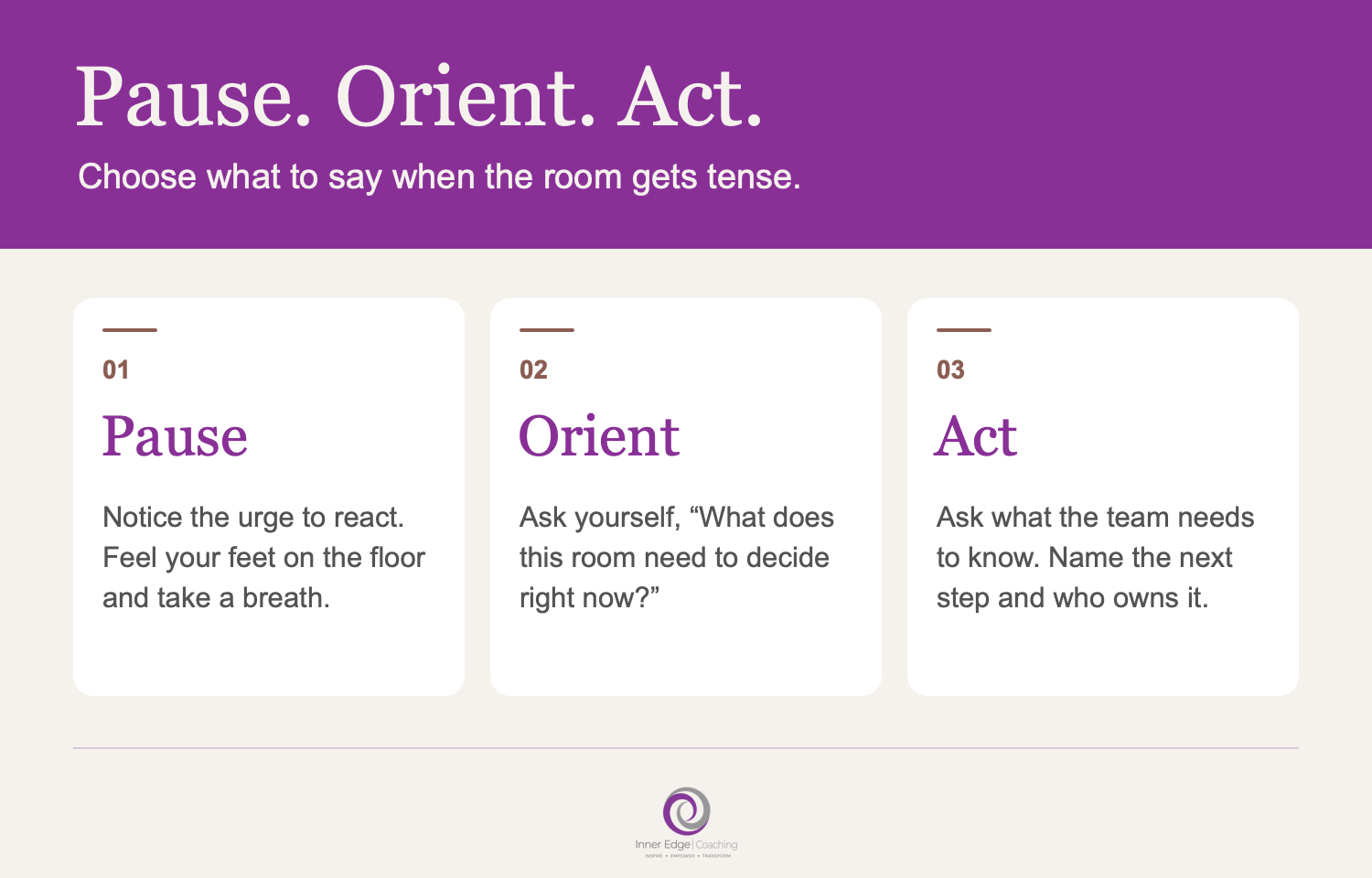
Pause. Orient. Act.
Pause. Catch the urge to interrupt, defend, or blame. Feel your feet on the floor and take a breath. Notice the sentence you’re about to say.
Orient. Ask yourself, “What does this room need to decide right now?” In her meeting, the immediate decision is what can move while the team waits for the missing piece.
Act. Ask a question that gets the information you need. Give people time to answer. Before the meeting ends, name the next step and who owns it.
Why it matters to the work
In a 2023 field study of 88 teams at a mortgage firm going through strategic change, leaders who scored higher on mindful attention kept exploring new ways of working even when the goals were unclear. That’s the flexibility she needs here. She walked in expecting one answer. Now she has to work with the answer she got. Harvey et al., Journal of Organizational Behavior
The immediate benefit is practical. The team leaves with work it can start, a time for the next update, and a person responsible for the schedule decision. But the way she handles the conversation also matters to the people who have to come back and work together tomorrow.
Think about what trust feels like from their side of the table. They can hear her say plainly that the missed commitment matters. They can also hear her ask the people closest to the work what they think is possible. When she listens to their answer and gives someone room to own the next step, she’s showing them she trusts their judgment, even on a difficult day.
The work of getting grounded starts before the meeting. It’s learning to notice what pressure does to her. Maybe she starts listening for who’s at fault. Maybe she’s already halfway through her response in her head. The more familiar she is with those signs, the easier it is to catch herself while she still has a choice about what to say.
That choice has a practical payoff. The team can start part of the work that afternoon. It also changes what happens after the meeting. When she follows up privately, she can hear where the person got stuck, be clear about what needs to change, and give them room to take responsibility for doing it differently next time. That’s how people get better at their work.
Over time, people learn what they can expect from her on a hard day. They learn whether she’ll listen when they bring her bad news, whether they’ll get feedback they can use, and whether she’ll trust them with the next decision. Those are some of the things people weigh when they decide whether they want to keep working for someone.
The project is still behind when she takes that breath. What she says next can get the work moving today. How she handles moments like this, over and over, helps determine whether the people doing the work can grow there and whether they want to stay.
The next time you’re in that room, what do you want your next sentence to do for the work and for the people doing it?
Originally published on Inner Edge Coaching on Substack, November 24, 2026.